Weather forecasting is entering a new era with Edge AI technology, bringing unprecedented accuracy to local predictions through advanced pattern recognition and real-time data processing capabilities.

🌤️ The Dawn of Intelligent Weather Prediction
Traditional weather forecasting has long relied on centralized supercomputers processing massive amounts of data from satellites, weather stations, and ocean buoys. While these systems have improved significantly over the decades, they often struggle with hyperlocal predictions—the kind that tells you whether it will rain on your specific street in the next hour. This is where Edge AI is revolutionizing the field, bringing computational intelligence directly to local devices and sensors.
Edge AI represents a paradigm shift in how we process and analyze weather data. Instead of sending all information to distant cloud servers, edge devices equipped with artificial intelligence capabilities can analyze weather patterns locally, reducing latency and enabling real-time predictions tailored to specific microclimates. This technology is transforming everything from agricultural planning to personal daily schedules.
Understanding Edge AI in Meteorological Context
Edge artificial intelligence refers to AI algorithms that run directly on endpoint devices rather than in centralized cloud infrastructure. In weather forecasting applications, this means deploying machine learning models on local weather stations, smart sensors, IoT devices, and even smartphones that can process atmospheric data instantly without requiring constant internet connectivity.
The advantages are substantial: reduced latency means faster predictions, enhanced privacy since sensitive location data doesn’t need to travel to external servers, lower bandwidth requirements, and continued functionality even when internet connections are unstable or unavailable. For weather forecasting specifically, these benefits translate into more responsive and accurate local predictions.
How Edge AI Processes Weather Data Differently
Traditional forecasting models use numerical weather prediction (NWP) systems that solve complex mathematical equations describing atmospheric physics. These models require enormous computational resources and take hours to generate forecasts. Edge AI complements this approach by using machine learning algorithms trained on historical weather patterns specific to local regions.
These neural networks can recognize subtle patterns in temperature fluctuations, humidity changes, barometric pressure shifts, and wind patterns that indicate imminent weather changes. By processing this data locally, edge AI systems can provide nowcasting—extremely short-term predictions spanning minutes to a few hours—with remarkable accuracy for specific locations.
🎯 Enhancing Local Weather Pattern Recognition
One of the most significant advantages of Edge AI in weather forecasting is its ability to learn and recognize patterns unique to specific geographical areas. Every location has its own microclimate influenced by topography, proximity to water bodies, urban heat islands, and vegetation patterns. Traditional large-scale models often miss these nuances.
Edge AI systems deployed in specific locations can be trained on years of hyperlocal data, learning how particular combinations of atmospheric conditions lead to specific weather outcomes in that exact area. For example, an edge device in a coastal city might learn that when temperature drops by three degrees while humidity increases by twenty percent over thirty minutes, fog typically rolls in within the next hour.
Machine Learning Models for Pattern Recognition
Several machine learning architectures prove particularly effective for weather pattern recognition at the edge. Convolutional Neural Networks (CNNs) excel at processing spatial weather data from radar images and satellite feeds. Recurrent Neural Networks (RNNs) and Long Short-Term Memory (LSTM) networks are ideal for analyzing time-series weather data, recognizing temporal patterns in how conditions evolve.
More recently, transformer-based models and attention mechanisms have shown promise in identifying complex relationships between multiple weather variables simultaneously. These models can be optimized and compressed to run efficiently on edge devices with limited computational resources while maintaining high prediction accuracy.
Real-World Applications Transforming Industries
The practical applications of Edge AI weather forecasting extend far beyond simply checking if you need an umbrella. Numerous industries are leveraging this technology to optimize operations, enhance safety, and reduce costs.
Agriculture and Precision Farming 🌾
Farmers are using edge AI weather stations deployed across their fields to make critical decisions about irrigation, fertilization, and harvesting. These systems can predict frost events hours in advance, allowing protective measures to be implemented. They can also optimize water usage by predicting rainfall with high spatial and temporal resolution, reducing waste while maximizing crop yields.
Vineyards, particularly sensitive to microclimatic conditions, benefit enormously from hyperlocal forecasting. Edge AI systems can monitor individual vineyard blocks, predicting conditions that might promote disease or affect grape quality, enabling targeted interventions.
Renewable Energy Optimization ⚡
Solar and wind energy production depends heavily on accurate weather predictions. Edge AI systems deployed at renewable energy installations can forecast cloud cover, solar irradiance, and wind speeds with unprecedented local accuracy. This enables better grid management, energy storage optimization, and more reliable integration of renewable sources into power networks.
Wind farms equipped with edge AI can predict turbulence and adjust turbine operations proactively, extending equipment lifespan while maximizing energy capture. Solar installations can forecast production capacity hours in advance, allowing utilities to manage backup power sources more efficiently.
Transportation and Logistics 🚛
Airlines, shipping companies, and ground transportation services are implementing edge AI weather systems to optimize routes, improve safety, and reduce delays. Airports equipped with edge weather intelligence can predict microburst events, fog formation, and icing conditions with greater accuracy, enhancing flight safety.
Delivery services use hyperlocal forecasts to optimize routing, avoiding areas about to experience severe weather. This reduces delays, protects goods sensitive to temperature or moisture, and improves customer satisfaction.
The Technology Stack Behind Edge Weather AI
Implementing effective edge AI weather forecasting requires integrating several technological components into a cohesive system. Understanding this stack helps appreciate both the complexity and the capabilities of these solutions.
Sensor Networks and Data Collection
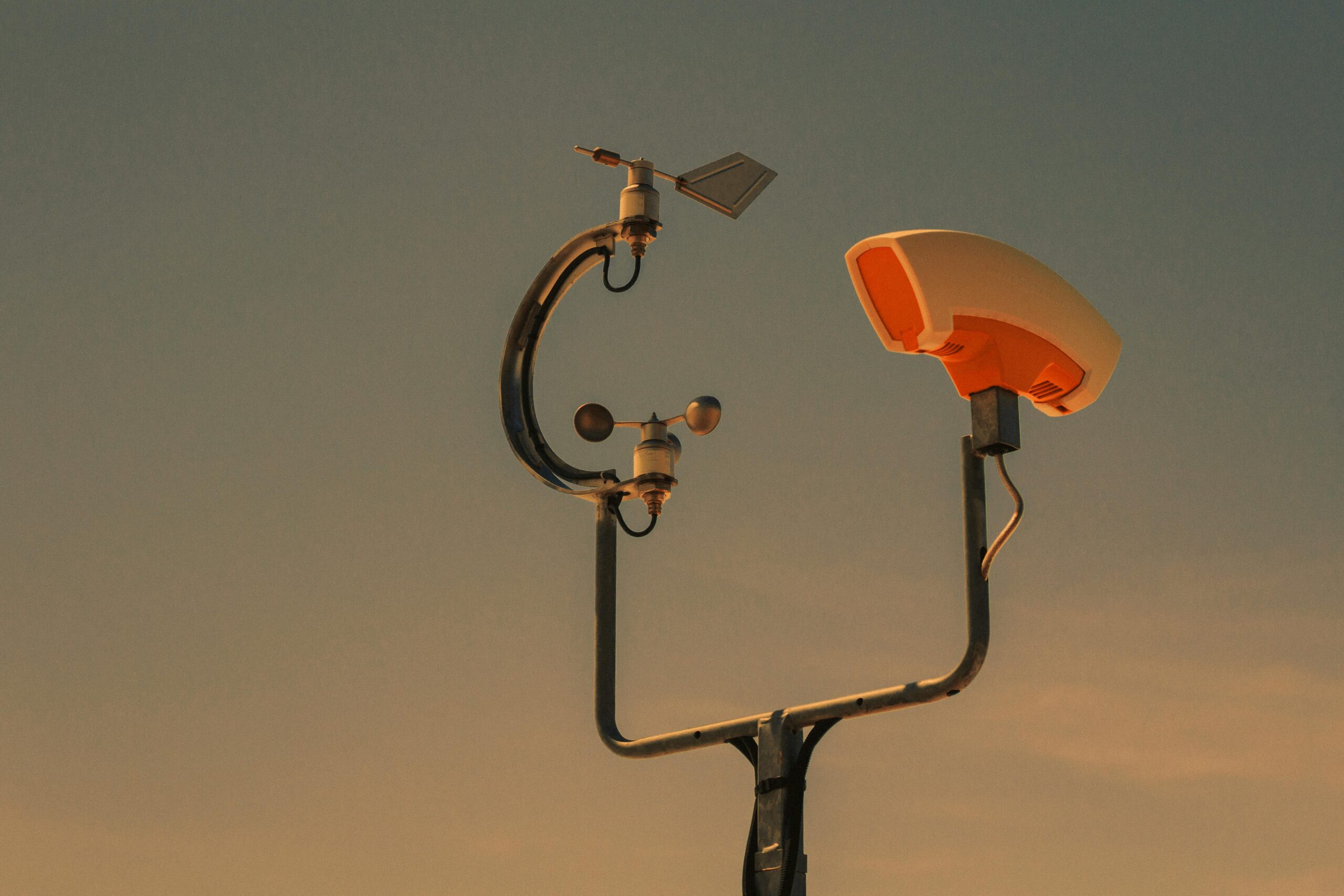
The foundation of any edge weather AI system is high-quality, real-time data. Modern sensor networks include traditional meteorological instruments—thermometers, barometers, hygrometers, anemometers—augmented with newer technologies like LIDAR for wind profiling, ceilometers for cloud height detection, and present weather sensors that automatically classify precipitation types.
IoT connectivity enables these sensors to form mesh networks, sharing data with nearby devices and creating a detailed picture of local atmospheric conditions. Edge AI devices can aggregate and process data from multiple sensors simultaneously, identifying patterns across spatial and temporal dimensions.
Edge Computing Hardware
Edge AI weather systems run on specialized hardware optimized for machine learning inference with minimal power consumption. This includes:
- Specialized AI accelerators like Google’s Edge TPU or NVIDIA’s Jetson platform designed for efficient neural network processing
- Low-power microcontrollers with integrated machine learning capabilities for simpler sensor nodes
- Weather-hardened enclosures protecting electronics from environmental conditions
- Solar panels and battery systems enabling autonomous operation in remote locations
- Local storage for caching data when connectivity is limited
Software and Model Optimization
Running sophisticated AI models on resource-constrained edge devices requires careful optimization. Techniques like model quantization reduce the precision of neural network weights, decreasing memory requirements and accelerating inference with minimal accuracy loss. Model pruning removes unnecessary connections in neural networks, creating leaner models that run faster.
Knowledge distillation transfers knowledge from large, complex models trained on powerful servers to smaller “student” models designed for edge deployment. These optimized models retain most of the predictive power while running efficiently on limited hardware.
📱 Personal Weather Intelligence at Your Fingertips
The democratization of edge AI weather technology means individuals can now access hyperlocal forecasts through smartphone applications and personal weather stations. These consumer-grade solutions leverage the edge AI capabilities built into modern smartphones and connect to networks of amateur weather stations.
Personal weather station manufacturers are increasingly incorporating edge AI features that learn your property’s specific microclimate. These devices can predict when your driveway will ice over, when conditions are ideal for outdoor activities, or when you should close windows before a storm arrives.
Smartphone applications using edge AI process sensor data from your device—barometric pressure, temperature, humidity—combined with location data and information from nearby users to generate hyperlocal forecasts. The AI models run directly on your phone, providing instant predictions without draining battery or consuming significant data bandwidth.
Overcoming Challenges in Edge Weather AI Implementation
Despite its tremendous potential, implementing edge AI for weather forecasting faces several technical and practical challenges that researchers and developers continue to address.
Data Quality and Sensor Calibration
Edge weather networks often incorporate sensors of varying quality and calibration states. Consumer-grade weather stations may provide less accurate readings than professional meteorological equipment. Edge AI systems must account for this uncertainty, implementing data validation techniques that identify and discount suspect readings while maintaining prediction accuracy.
Machine learning algorithms can learn to compensate for systematic sensor biases, but this requires careful training and periodic recalibration. Distributed networks benefit from redundancy—multiple sensors in an area can cross-validate readings, improving overall data quality.
Model Training and Updating
Weather patterns evolve over time due to climate change, urban development, and other factors. Edge AI models must be updated periodically to maintain accuracy. This presents challenges when devices operate in remote locations with limited connectivity.
Solutions include federated learning approaches where edge devices collaborate to improve shared models without transmitting raw data, and incremental learning techniques that allow models to adapt continuously to new patterns while retaining knowledge of historical conditions.
Power Consumption and Environmental Durability
Edge devices deployed in outdoor environments must withstand temperature extremes, precipitation, wind, and solar radiation while operating continuously. Balancing computational capability with power efficiency remains a critical design challenge, particularly for solar-powered remote stations.
Advances in low-power AI chips and energy harvesting technologies continue to extend the capabilities of edge weather systems, but designers must still make careful tradeoffs between model complexity, prediction frequency, and power availability.
🔮 The Future of Edge AI Weather Forecasting
The trajectory of edge AI weather forecasting points toward increasingly sophisticated, ubiquitous systems that provide seamless weather intelligence integrated into every aspect of daily life and business operations.
Integration with Smart Cities and IoT Ecosystems
Future smart cities will incorporate edge weather intelligence throughout their infrastructure. Traffic lights might adjust timing based on precipitation forecasts, building management systems could optimize HVAC operations using hyperlocal temperature predictions, and emergency services would receive automated alerts about dangerous conditions in specific neighborhoods.
This integration creates positive feedback loops—more sensors generate better data, improving model accuracy, which enables new applications that justify deploying additional sensors. The result is a comprehensive environmental intelligence network benefiting entire communities.
Citizen Science and Crowdsourced Weather Networks
The proliferation of personal weather stations and smartphone-based observations is creating vast crowdsourced weather networks. Edge AI systems can aggregate and process this distributed data, filling gaps between official weather stations and providing unprecedented spatial resolution.
Machine learning algorithms filter out erroneous reports while identifying genuine observations, creating a democratic weather observation system where anyone can contribute to improved forecasts for their community.
Climate Change Monitoring and Adaptation
Edge AI weather networks deployed at scale become valuable tools for monitoring climate change impacts at local levels. By tracking how microclimates evolve over years and decades, these systems help communities understand their specific vulnerabilities and develop targeted adaptation strategies.
The granular data from edge networks complements large-scale climate models, bridging the gap between global projections and local impacts that actually affect people’s lives.
Getting Started with Edge AI Weather Technology
For individuals and organizations interested in leveraging edge AI for weather forecasting, several pathways exist depending on technical expertise and specific needs.
Consumer Solutions
Personal weather stations from manufacturers like Ambient Weather, Davis Instruments, and Netatmo increasingly incorporate AI-enhanced forecasting features. These devices connect to cloud-based AI services but also process data locally for instant insights.
Smartphone applications utilizing edge AI for weather prediction are becoming more sophisticated. These apps use your phone’s sensors combined with machine learning models optimized for mobile processors to generate personalized forecasts.
Professional and Research Applications
Organizations requiring more sophisticated solutions can deploy custom edge AI weather systems tailored to specific needs. This typically involves partnering with meteorological technology companies or developing in-house solutions using open-source machine learning frameworks adapted for weather prediction.
Universities and research institutions are actively developing new edge AI weather forecasting techniques, often making their models and code publicly available. These resources provide excellent starting points for those with technical expertise looking to implement custom solutions.
🌍 Transforming Our Relationship with Weather
Edge AI weather forecasting represents more than just technological advancement—it fundamentally transforms how we interact with and respond to atmospheric conditions. By providing accurate, hyperlocal predictions in real-time, these systems empower better decision-making at every level, from individual daily choices to major infrastructure investments.
The shift from relying on centralized forecasts covering broad regions to having personalized weather intelligence for your specific location mirrors broader trends in technology toward customization and localization. Just as streaming services recommend content based on your preferences and navigation apps optimize routes for your specific journey, edge AI weather systems deliver atmospheric predictions tailored to your exact needs and location.
This technology also makes weather forecasting more resilient. Distributed edge systems continue functioning even when central servers or internet connections fail—a critical advantage during severe weather events when accurate information matters most.
Embracing Weather Intelligence in Daily Operations
Successfully integrating edge AI weather forecasting into personal or organizational routines requires more than just deploying technology—it involves developing new workflows and decision frameworks that leverage hyperlocal predictions effectively.
Start by identifying decisions currently affected by weather uncertainty. These might include outdoor activity planning, agricultural operations, energy management, or logistics coordination. Evaluate how improved forecast accuracy and reduced prediction timeframes could enhance these decisions. Then implement edge AI solutions progressively, beginning with applications offering the clearest return on investment before expanding to more complex use cases.
Training and change management are equally important. People accustomed to traditional forecasts need time to develop trust in new AI-powered systems and learn how to interpret their outputs effectively. Demonstrating accuracy through parallel operation—running edge AI predictions alongside traditional forecasts and comparing results—builds confidence and identifies areas for improvement.

The Convergence of Multiple Technologies
The power of edge AI weather forecasting multiplies when combined with other emerging technologies. Blockchain systems could create transparent, tamper-proof records of weather observations, valuable for insurance claims and agricultural verification. Augmented reality interfaces might overlay real-time weather predictions onto your view of the environment through smart glasses. Autonomous vehicles will rely heavily on edge weather AI for safe navigation in challenging conditions.
These convergences create synergies where the whole exceeds the sum of parts. A delivery drone, for example, might use edge AI weather predictions to plan routes avoiding turbulence, blockchain to create verifiable flight logs, and AR to display flight paths to ground controllers.
Weather forecasting powered by Edge AI is not merely an incremental improvement over existing systems—it represents a fundamental reimagining of how we understand and predict atmospheric conditions. By bringing intelligence to the edge, closer to where weather actually impacts our lives, these systems deliver unprecedented accuracy, responsiveness, and personalization. As the technology continues evolving and proliferating, weather intelligence will become seamlessly integrated into the fabric of daily life, enabling smarter decisions, safer operations, and more efficient resource utilization across every sector of society. The future of weather forecasting is local, intelligent, and happening right now at the edge.